
The calculus of regional growth in a fractured landscape.
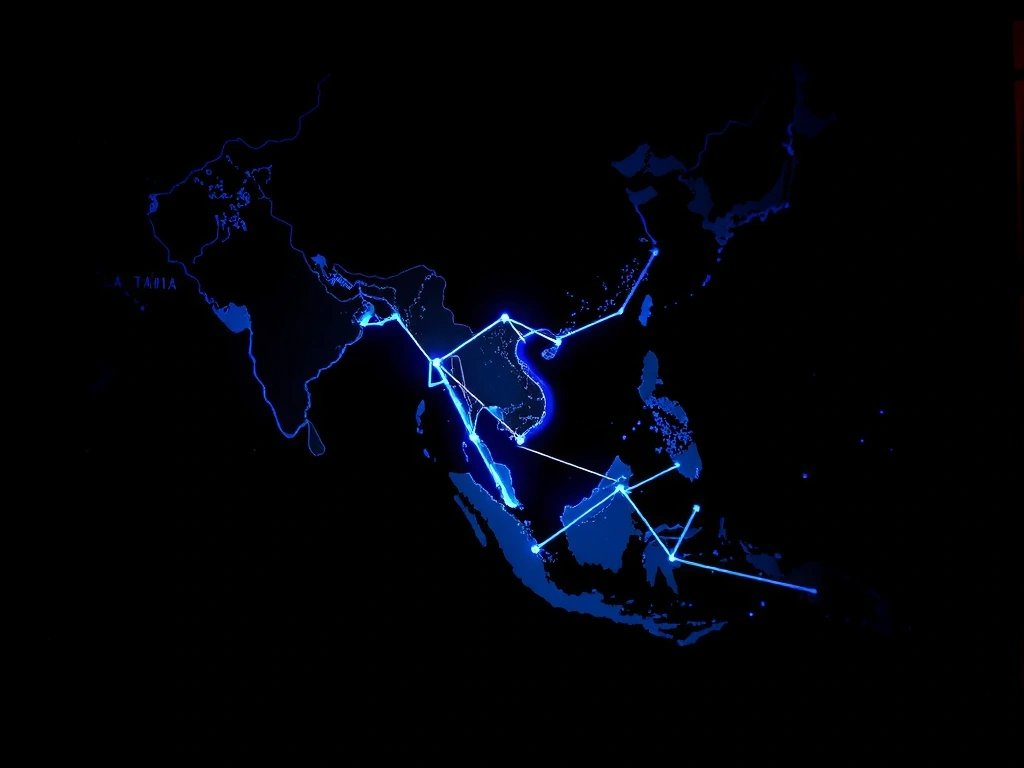
Economic modeling in Southeast Asia requires more than just processing raw numbers. It demands a rigorous architectural framework that accounts for informal economies, fluctuating currency pegs, and varying reporting standards across the ASEAN+3 bloc.
Aggregated Intelligence: Our Primary Data Influx
We balance high-velocity indicators with structural macroeconomic data to ensure our economic forecasts remain grounded in reality. Our modeling engine ingests over 140 disparate streams daily.
Regional Focus Area:
GMS (Greater Mekong Subregion) + Jakarta-Singapore Corridor
Official Institutional Feeds
Direct integration with API endpoints from the Bank of Thailand (BOT), General Statistics Office of Vietnam, and the Asian Development Bank. This forms our baseline for inflation and trade balance projections.
Non-Traditional Proxies
We utilize night-time luminosity satellite data and maritime cargo AIS tracking to verify manufacturing output in regions where official industrial production reporting lags by 45-60 days.

Verification Standards
How we ensure data projections remain statistically significant and resilient to local market volatility.
| Verification Tier | Standard Protocol | Tolerance Threshold |
|---|---|---|
| Macro-Temporal Sync | Seasonal adjustment using X-13ARIMA-SEATS for all agricultural exports from Thailand and Vietnam. | < 0.2% variance |
| Cross-Border Reconciliation | Triangulating export data from Malaysia against import filings in Singapore and China to identify shadow trade. | +/- 1.5% discrepancy |
| Volatility Filtering | Removing statistical noise from short-term currency fluctuations using 20-day weighted moving averages. | Dynamic (IQR based) |
| Institutional Confidence | Comparison of internal P-models against consensus forecasts from the IMF and World Bank. | 95% Confidence Interval |
Debunking Data Misconceptions
"Regional growth in Asia can be measured through a single unified index."
Pan-Asian markets are heterogeneous. A surge in Vietnam's manufacturing may correlate with a slowdown in Thai automotive exports. We model these as a series of interconnected nodes rather than a monolithic bloc.
"Real-time data is always superior to historical trend analysis."
Real-time datasets often contain significant noise (e.g., holiday spending spikes). Our methodology applies a historical decay function to ensure immediate spikes are contextualized within long-term cycles.
Honest Boundaries in Modeling
Analytical integrity requires acknowledging where the data ends and speculation begins. PanAsia Metrics operates under a strict set of constraints to avoid provide misleading certainty in volatile markets.
-
Political Neutrality
Our algorithms do not weight forecasts based on political sentiment unless it has a direct, measurable impact on central bank policy rates.
-
Exclusion of Black Market Data
While significant, informal economies are excluded from our primary indices due to lack of verifiable year-on-year auditing trails.
-
Lag Time Acceptance
We prioritize accuracy over speed. If a data source is unverified, we will wait for the 48-hour secondary audit window before updating our public projections.
Interpreting Our Models
New to PanAsia Metrics? Our methodology is designed for institutional investors and regional policy planners. Start by reviewing our White Paper on Trade Velocity or explore our Sectoral Weighting framework.